

counties across texas
A Forward Texas Spotlight Series
The Counties Across Texas spotlight series from the Texas Forward Party takes us through the largest counties in Texas to the smallest: a journey that reminds us just how big, bold, and beautifully diverse this state truly is. From city skylines to ranch roads, from classrooms to cattle pens, every county has a story worth telling.

Starr County vs. Hansford County
This match-up spans the entire length of the state, from the Rio Grande Valley to the top of the Panhandle. Both are border counties: one south, one north; that anchor the extremities of Texas.
Hood County vs. Crosby County
This match-up pairs a booming exurban destination with a quiet agricultural stronghold. One is managing the challenges of popularity and rapid growth; the other is fighting to preserve its farming heritage and rural way of life.
San Patricio County vs. Wheeler County
In this match-up, we contrast the coastal bend with the panhandle gateway. San Patricio County looks out to sea; Wheeler County looks up the plains. Both are working-class communities where jobs, infrastructure, and economic opportunity are the top priorities.
Harrison County vs. Jim Hogg County
This match-up spans the state from the Louisiana border to the South Texas brush country. One is defined by its old-south charm and wetlands; the other by its mesquite scrub and cattle legacy. Both are essential threads in the fabric of Texas culture.
Wise County vs. Crane County
This match-up compares the rapidly growing exurbs of Wise County with the stark energy of Crane County. One is managing the pressure of becoming suburban; the other is sustaining a self-reliant economy in the oil patch.
Walker County vs. Mills County
This match-up brings us to the historic pine forests of Walker County and the rolling ranch lands of Mill County. Together, they represent the balance between preserving our state’s legacy and cultivating its land.
Coryell County vs. Garza County
Coryell County and Garza County highlight two Texas traditions: one anchored in military service and small-town growth, the other in ranching, mesas, and High Plains endurance. Together, they show how Texans unite around service, community, and local leadership.
Orange County vs. Kimble County
Orange County and Kimble County highlight two landscapes shaped by water: one along the Gulf Coast and one fed by spring-fed Hill Country rivers. Together, these counties show the diversity of Texas geography and the shared desire for community stability and a future built on fairness.
Henderson County vs. Mason County
Henderson County and Mason County represent two beloved strands of Texas identity: lakeside living in the East Texas woods and the slow, rolling beauty of the Hill Country. Both counties share a deep appreciation for community ties, natural beauty, and leadership that understands local needs rather than partisan demands.
Angelina County vs. Fisher County
Angelina County and Fisher County represent two versions of Texas tied together by strong community pride and deep regional heritage. Together, they reveal how Texans from all backgrounds value self-reliance, community ties, and leadership that reflects their everyday realities.
Victoria County vs. Hardeman County
Victoria County and Hardeman County show two sides of Texas: one positioned at the crossroads of South Texas commerce, the other shaped by quiet Red River ranchlands and frontier history. Together, they demonstrate that Texas communities thrive when leadership reflects local needs.

Bowie County vs. Baylor County
Bowie County and Baylor County reflect two very different versions of Texas life: one shaped by a vibrant border metro and the other by the wide-open quiet of the Rolling Plains. Together, the counties show how Texas identity blends regional bustle with rural endurance, and how both deserve representation that reflects their lived experiences.
Liberty County vs. Hudspeth County
Liberty County and Hudspeth County sit more than 700 miles apart, yet together they reflect how broad and varied the Texas experience truly is. But both counties share the same desire for strong local representation and a Texas future that works for the people who call these places home.
Bastrop County vs. Coke County
Bastrop County and Coke County reflect the diversity of Texas landscapes: from the pine forests east of Austin to the mesas and quiet plains of West Texas. Together, they show the importance of systems that reflect local needs, not statewide assumptions.
Hunt County vs. Knox County
Hunt County and Knox County highlight two different strands of Texas life: one driven by university energy and growth along the I-30 corridor, the other defined by quiet plains, wheat fields, and ranching towns where community ties run deep. Together they show that whether a county is growing or holding steady, Texans value accountability, connection, and leaders who put people first.
Potter County vs. Concho County
Potter County and Concho County capture two very different but deeply connected forms of Texas resilience. Together, they remind Texans that strength comes from both our population centers and our rural roots; and that each deserves thoughtful leadership.
Tom Green County vs. Shackelford County
Tom Green County and Shackelford County reflect two chapters of Texas history — one, a growing West Texas city built around the Concho River, and the other, a historic ranching county where the frontier never feels far away. Both counties show that Texas communities thrive when heritage and progress work hand-in-hand.
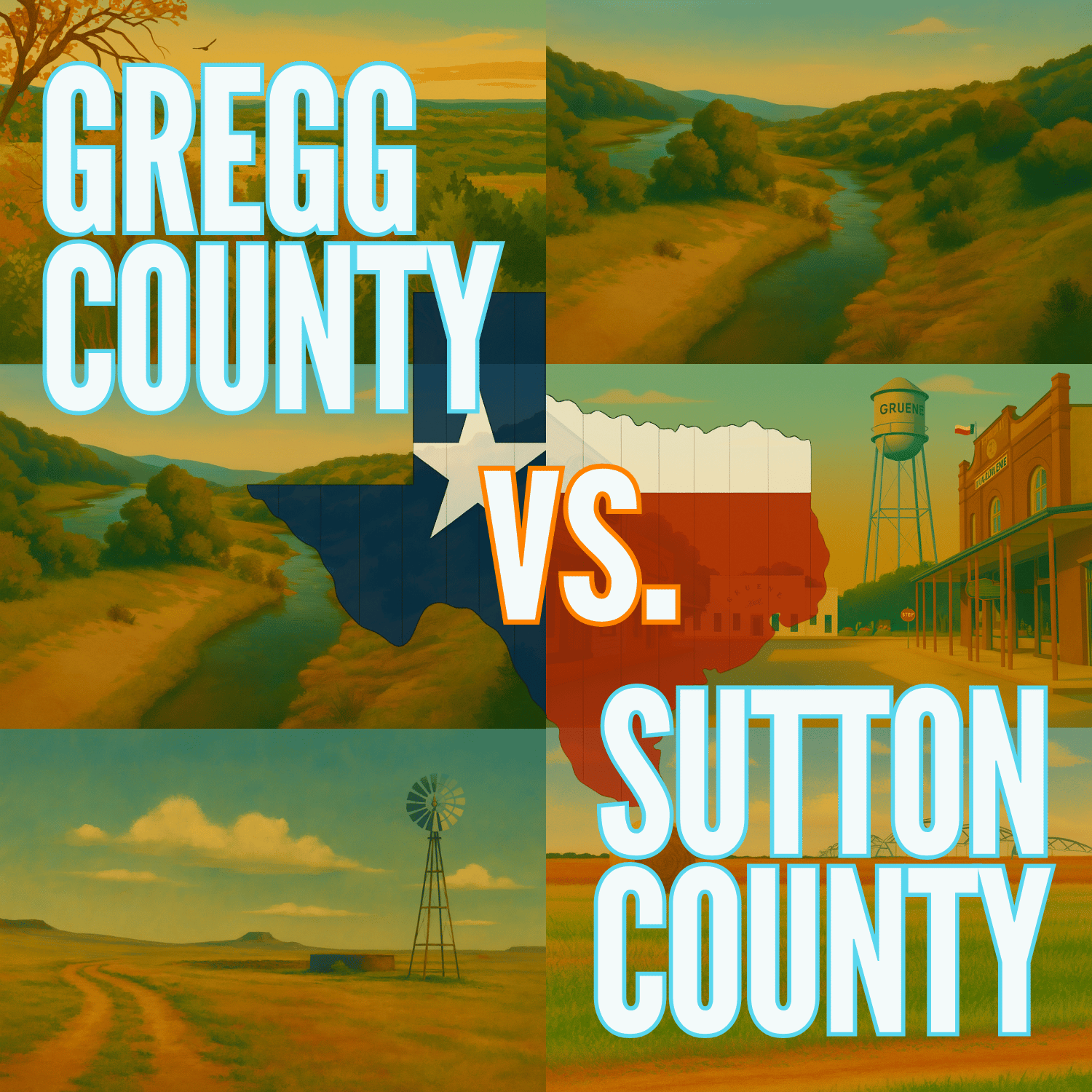
Gregg County vs. Sutton County
Gregg County and Sutton County sit in two very different corners of Texas — one among the pine forests of East Texas, the other on the limestone hills of the Edwards Plateau. Together, these counties reflect two sides of Texas grit: industrial growth and frontier tradition.