

Texas Education Overview
The Texas Forward Party supports Education as a critical component for the success of a well-
informed and engaged citizenry of Texas. Adequate, equitable resources for all students should
be provided for Pre-K through college including career training and certification for students
who choose to not pursue a post-secondary path. A common core of humanities, STEM, and
civics equips students with the knowledge and skills needed to confidently navigate our
increasingly complex and ever-changing world and events and to plan for a sustainable future.
Moreover, the Texas Forward Party believes the majority of local educational operations in
Texas can be effectively addressed through local policy-making developed and administered by
direct, accurate and equal community representation by school board members and other
elected officials.
Strategies for Improvement:
The Texas Forward Party agrees with this approach and applauds especially the IDA plans that help each
school campus to ensure they have safety measures in place to allow only authorized individuals to enter
schools. These initiatives are thorough, preventative, and adaptable for varying school environments.
However, safety procedures are highly dependent on the implementation by teachers and staff and, in
turn, their experience and quality in the workplace. Due to this, Texas Forward Party believes that if the
recruiting, retention, and support of quality faculty members increases, safety and security will also be
enhanced.
The Texas Forward Party advocates for funding and local accommodations within state guidelines to
ensure districts can adequately meet student and staff safety needs as well as newly created state
requirements.
School Funding
The funding of schools in the State of Texas is a complex mix of dedicated statewide funding,
federal funding, and the revenue from property taxes. Beyond the Basic Allotments and Tier 1
Maintenance and Operations (M&O) calculations, the property tax revenue is re-allocated
between districts to equalize the variances in property wealth. In the final numbers, you will
find funding for additional resources for any students with special needs or in special
programs.
Recommendations:
Adequate funding for all students is an imperative and must be an inalienable budget
item for the state legislature[1] . This funding must be adjusted bi-annually for inflation or
other factors that may deteriorate the planning and execution of a top-quality education in
Texas. This funding cannot be dependent on unrelated legislative issues or projects.
We believe every school receiving public funds should be held accountable to the same
standards regarding student progress. This accountability applies to public schools (including
charter schools) and private ones. SB2 created during the 89th Legislative session established
Education Savings Accounts (ESAs) to provide public funds to students attending private
schools or participation in home schooling. SB2 specifically relieves private schools from a
requirement to publish student test scores. Because schools receive funding from public
sources, we believe all students, whether public (including charter schools) or private, should be
evaluated using the same TEA-approved assessments with accompanying A-F letter-grade
scores. These test results should be available to the public in order to ensure the students are
receiving the best education as intended by the state. Accountability ratings for all schools
should be available to the public, as well.
Recruit, Support and Retain Teachers and Principals
The Texas Forward Party understands the demanding nature of anyone working as an
educational professional. The solid recruitment, support and retention of all professionals
involved lays a strong foundation of continuity and trust for students.
Because the salaries for educational professionals in Texas are below national averages, it is
difficult to recruit and retain personnel.
In an article published by the Texas State Teachers Association, dated April 1,2025, it is noted
that “Texas teachers, on average, are paid more than $9,000 less than their national peers, and
Texas spends more than $5,000 less per student than the national average, ranking our state 46th,
near the bottom of the barrel, in that important measure of financial commitment to public
education.”
Grading Texas – Texas State Teachers Association
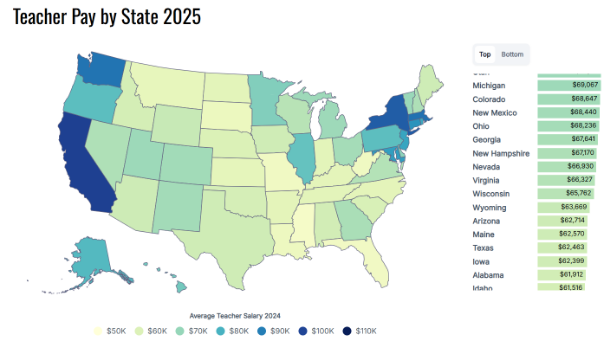
Source: US Department of Education Teacher Pay by State 2025
Recommendations:
The Texas Forward Party gives our full support to our educational resource pool. It is our goal
to encourage all school districts to use recent allocations of funding increases from the State to
augment and enhance salaries for any personnel involved. Even with the most recent increase
in school funding, Texas is still lagging behind other states in providing economic support to
our educational professionals. We encourage our legislators to give priority to backing up their
own goal of providing a top quality education in all schools.
Build a Foundation for Reading and Math
Assessments have shown that it is of critical importance to be sure students have
developed proficiency in both Math and Reading by the 3 rd Grade when statewide assessments
are conducted. The foundation of learning begins long before, but our students begin to apply
all preliminary learning to more complex thinking and reasoning.
Recommendations:
A curriculum should be designed to meet students where they are in terms of cognitive,
emotional, and social development. Incorporating developmental psychology into curriculum
design ensures that the content is age-appropriate and that learning objectives align with
students’ current abilities and potential for growth.
The State Board of Education is required to review curriculum every eight years.
The SBOE could accommodate districts by preparing a 5-year plan that identifies the specific
subject areas to be reviewed each year. This will allow school districts to be able to prepare
instructional planning and for publishers to be able to prepare instructional materials. We
believe that school districts should maintain their autonomy to select the state curriculum that
best fits students’ needs, research-based instructional strategies, and community values.
Student Evaluations
On behalf of our students, educators and administrators, the Texas Forward Party supports the
need for assessments that accurately reflect the benchmarks and progress being made in
educational settings. We are open to alternative standardized evaluations beyond the often
controversial STAAR test.
Connect High School to Career and College
Although we often focus on the elementary and secondary curriculum and results, we
must always keep in mind that the end goal for our educational system is to support the post-
secondary goals of our students for college or career readiness. With the current challenges of
the cost of colleges, we recognize our students also need to have options to graduate with
certifications for industries or trades that will allow them to become part of our vibrant
economical arena.
These bills were presented to the 89th Texas Legislature:
● HB 20 (Gates, Schwertner) requires the commissioner of education to establish and
administer the Applied Sciences Pathway program to provide opportunities for students
to concurrently earn high school diplomas and certificates from institutions of higher
education. The commissioner will be required to approve participation in program
partnerships between school districts or open-enrollment charter schools and
institutions of higher education.
● SB 2314 (Creighton, Wilson) requires the Texas Higher Education Coordinating Board
to create, maintain, and administer, as a direct admissions and financial aid portal, an
electronic platform and submission portal, known as My Texas Future
(MyTexasFuture.Org), to facilitate the awareness and application of public high school
students into institutions of higher education. 5-19-25 Signed by the Governor;
Recommendations:
The Texas Forward Party recommends that our assessments and curricula must move beyond
rote memorization and high-stakes testing to measure how students navigate real-world
challenges, adapt to new situations, and persist in the face of setbacks. It is our hope that our
educational system can put a focus on producing resilient, emotionally mature, and critical
thinkers.We should embed social-emotional learning and problem-based projects throughout
the school day, ensuring that “assessment” reflects empathy, collaboration, ethical reasoning,
and creative problem solving as much as academic content.
Book Bans
The 88th Texas Legislature passed HB900 which creates regulations for removing library
materials from the school library.
The 88th Texas Legislature, Regular Session, 2023, passed HB 900, amending TEC §33.021 to
require the TSLAC, in consultation with the SBOE, to adopt voluntary standards for school
library services, other than collection development, that a school district must consider in
developing, implementing, or expanding library services. …….. The school library collection
development standards must be reviewed and updated at least once every five years, and
include a collection development policy that does the following:
● Prohibits the possession, acquisition, and purchase of harmful material, as defined by
Texas Penal Code §43.24; library material rated sexually explicit material by the selling
library material vendor, or library material that is pervasively vulgar or educationally
unsuitable as referenced in Pico v. Board of Education, 457 U.S. 853 (1982)
● Recognizes that obscene content is not protected by the First Amendment to the United
States Constitution
● Is required for all library materials available for use or display, including material
contained in school libraries, classroom libraries, and online catalogs
● Recognizes that parents are the primary decision makers regarding a student’s access to
library material
● Encourages schools to provide library catalog transparency
● Recommends schools communicate effectively with parents regarding collection
development
● Prohibits the removal of material based solely on the ideas contained in the material or
personal background of the author of the material or characters in the material
Recommendations:
The Texas Forward Party agrees with this approach for determining the suitability of
materials placed in school libraries. Furthermore, we believe school board members should
follow these recommendations and avoid banning materials solely based on personal biases
unencumbered by supporting data.
Additionally, The Texas Education Agency (TEA) provides the following guidance:
“In school libraries, students are afforded the opportunity to self-select texts as part of literacy
development. While librarians are trained in selecting materials in accordance with Board
policy and the outlined selection criteria and may provide guidance to students in selecting
texts, the ultimate determination of appropriateness lies with the student and parent. “
Regarding the removal of library materials, “The major criterion for the final decision on
challenged library material is the appropriateness of the resource for its intended educational
use. The plurality opinion in Bd. of Educ. v. Pico, 457 U.S. 853 (1982) uses the standard that no
challenged instructional resource shall be removed solely because of the ideas expressed
therein. The opinion allows the removal of materials because they are pervasively vulgar or
based upon the lack of educational suitability of the library material. Further, making a
determination of appropriateness will include a review of and compliance with 47 U.S.C.
§254(h)(5), Texas Penal Code §43.24(a)(2), and Texas Penal Code §43.24(b).
https://tea.texas.gov/texas-schools/school-boards/efb-local-library-materials.pdf
Our approach to removing books from schools and libraries is:
Books may be banned for obscenity per SBOE rules.
Books may not be banned because of the personal background of the author.
Books may not be banned because of a character in the book.
Books may not be banned because of the appearance of a particular word.
Books may not be banned if the same words spoken orally are protected by the
Constitution or Bill of Rights.
Student education regarding books must include the development of a filter capable of
identifying material that is worthy of question and discussion.
De -Funding Libraries & Librarians
It is the greatest surprise to discover there are no state or federal laws that require schools to
have libraries. This revelation has become apparent to school districts across Texas and the rest
of the country. When school funding is limited and budgets are stretched, the school libraries
are apparently an easy target and tool for balancing the budget. Library services provide
technology, training and resources for building skills and providing research accessibility.
An article by Debra Kachel, Professor of School Library and Information Technologies Program, Mansfield
University of Pennsylvania The calamity of the disappearing school libraries - The Edvocate puts this
dilemma into perspective.
“From coast to coast, elementary and high school libraries are being neglected, defunded, repurposed,
abandoned and closed.The kindest thing that can be said about this is that it’s curious; the more accurate
explanation is that it’s just wrong and very foolish.A 2011 survey conducted with my graduate students of 25
separate statewide studies shows that students who attend schools with libraries that are staffed by certified
librarians score better on reading and writing tests than students in schools without library services. And it is
lower-income students who benefit the most. This clear empirical evidence has had little impact on budget
cutters, however. They act – mistakenly – as though there is no link between libraries and educational
achievement.
One reason they cut is because they can. …….
The research is clear. School librarians are an integral part of a world-class, 21st-century education.
Also at work in the minds of budget cutters may be the hoary falsehood that the internet has made the need
for libraries obsolete.
But those who think that the internet replaces a library must think it is okay to use WebMD instead of going
to a doctor.
Librarians teach information literacy – how to separate the useful from the less useful, the credible from the
inaccurate, and how to navigate the internet safely.”
However, allowing each state and each school district to decide how funds should be expended to educate
students and provide library services has brought about huge inequities particularly in impoverished
communities with resource-starved schools.
….In his State of the Union Address, President Obama said that “In the 21st century, one of the best anti-
poverty programs is a world-class education.
Yet, until now, federal education policy and legislation have neglected to support the role of school librarians.
That needs to change. We need a national agenda and our elected officials to take a stand and ensure equity
of library services and certified school librarians to teach the next generation to find and apply information to
solve problems, think critically, and develop innovations.
Until such time, we shortchange our students and our future.”
Recommendations:
The Texas Forward Party supports having fully functional school libraries and librarians. It is
our goal to encourage all school districts to use recent allocations of funding from the State to
rebuild their library programs. We will encourage the Legislature to make libraries and
librarians a requirement for all schools. Additionally, we encourage our legislators to create a
line item in the Public Education budget to establish library services to all schools.
Displaying of Ten Commandments in Public Schools
The 89th session of the Texas Legislature passed Senate Bill 10 which requires the display of The
Ten Commandments in each elementary school classroom.
Recommendations:
The Texas Forward Party believes this law goes beyond the boundary between religion and state
laws and will not withstand scrutiny by the Supreme Court. We encourage our legislators to
revoke this law.
Higher Education
Attaining a post-secondary education that provides critical instruction and enables Texans to
earn competitive wages is a priority for many Texans and is a priority for the Texas Forward
Party. But the dream to have the opportunity to access post-secondary education must be
affordable to all Texans and there must be a return on that investment of time and money.
Texas Forward Party believes in aspiring to build a higher education system that partners
students, colleges, and industries to produce highly-skilled and highly-employable workers. As
a result, the Texas Forward Party must foster the connections between these stakeholders, and
prioritize funding and subsidizing of education for careers in high-demand areas.
Our institutions of higher education are not merely a destination of the educational path our
students choose. It is an interim development oasis where high school graduates become
exposed to a world beyond their own backyard. This is where our students will experience
awareness of new and exciting ideas and cultural opportunities. This is where our students
develop into competent adults ready to shoulder the burden of our past efforts to establish a
vibrant economy, an ethical election system, innovation, entrepreneurship, and respect for our
citizenry.
In recent years, our institutions of higher education have found themselves at the center of a
spate of cultural issues spearheaded by both federal and state lawmakers. Wielding the threat
of withholding funding or certification, various political groups have pressured the top
administrators of our universities and colleges to alter curriculum and business practices along
with limiting First Amendment rights of students to express ideas that may seem as liberal
ideology. The definition of “Liberal” found on the Internet (which is, of course, the source of
knowledge for so many students) is:
1. willing to respect or accept behaviour or opinions different from one’s own; open to new
ideas:
Recommendations:
The Texas Forward Party recommends that our institutions of higher education continue to
push back against unreasonable and possibly unconstitutional demands from various political
sources. Our legislators are encouraged to think and act independently when cultural and
business decisions are at stake.
